65% of Runners Get Injured Every Year. Here's Why Your Form Is the Culprit.


IT band pain — a knee ache that flares at mile three and cost me three race seasons of consistent training right when my fitness was finally clicking. Running injuries like this one hit me hardest in week 8 of marathon prep, at a pace well within what should have been a comfortable zone. With nothing left to lose, I let a friend film my running form from the side for the first time. When I was ready to accept that my form — not my mileage — was the culprit, I finally started making real progress. What the video revealed changed everything.
Somewhere between 50 and 79 percent of recreational runners develop an injury every year — knee pain, shin splints, IT band syndrome, stress fractures — and the range across studies is consistent enough to be unsettling. If you run regularly, you will probably get hurt, and statistically you probably already have.
It's not just about how much you run. The conventional explanation for running injuries is overtraining, and it carries truth: do too much, too fast, and the body breaks down. That's partly true. But it misses the more fundamental driver: most running injuries aren't caused by how much you run. They're caused by how you run.
Form flaws create uneven load distribution. That load accumulates silently — no pain, no signal — until a threshold is crossed and something gives. The injury feels sudden. The cause has been building for months.
Here are the five most common running form flaws, what each one does to your body, and the specific injuries they produce. Understanding running gait mechanics — even at a basic level — is the single highest-leverage change most recreational runners can make for injury prevention.
📱 Want to know your own running form score? GaitLab uses AI to analyze your running form from a 20-second phone video — free, in under 60 seconds. You'll get a scored breakdown of each form flaw above, plus a personalized 4-week fix plan.
Download for iOS → | Download for Android →
1. Overstriding — The #1 Running Form Injury
What it is: Your foot lands ahead of your centre of mass with each stride. Most recreational runners overstride by 10–14cm on every footstrike without realising it.
Why it happens: Reaching forward feels faster. But overstriding creates a braking force that actually slows you down and loads the kinetic chain incorrectly on every single landing.
What it does to your body: Landing with a nearly straight leg ahead of the hips transmits impact force directly up the chain. Research shows overstriding by 14cm increases impact loading rates by 7.8% compared to a midfoot strike under the hips — and produces 6.3 times the braking force of a properly placed footstrike. Your feet land 40,000 times in a typical marathon. Each overstriding step compounds those loads.
The injuries it causes: Shin splints, stress fractures, patellofemoral pain, and IT band syndrome. Overstriding is one of the most mechanically consistent predictors of running injury — and one of the most fixable.
The fix:
- Increase cadence from 158 to 168 SPM — this naturally shortens stride length without conscious effort
- Focus foot-strike under the hips, not ahead of them
- Film yourself from the side: if your knee is nearly straight at landing, you are overstriding
- Single-leg deadlift drills build the hip stability needed to maintain a shorter, more powerful stride
For a deep dive into this specific flaw, see: How to Stop Overstriding: The #1 Running Form Mistake.
2. Hip Drop (Trendelenburg Gait): The Hidden Driver of IT Band Syndrome
What it is: Your hips tilt side to side as you run — the unsupported hip drops with each step rather than staying level.
Why it happens: Weak hip abductors, primarily the gluteus medius. This muscle is responsible for stabilising the pelvis during single-leg stance. Most runners never specifically train it.
What it does to your body: When the hip drops, the entire kinetic chain compensates. The knee tracks inward, the IT band is stretched repetitively, and the lower back rotates to maintain balance. Every step loads the hip, knee, and band unevenly.
The injuries it causes: IT band syndrome, patellofemoral pain, hip bursitis, lower back pain. Hip drop is one of the most consistent predictors of running injury in biomechanical research.
The fix:
- Clamshells: 3 sets of 20 each side, three times per week
- Lateral band walks: 2 sets of 15 steps each direction
- Single-leg squats: 3 sets of 10 each side (use a wall for balance initially)
- Single-leg Romanian deadlifts: 3 sets of 8 each side — the most direct fix for gluteus medius weakness
3. Excessive Forward Trunk Lean: How Posture Becomes a Running Injury Risk
What it is: Bending forward at the waist rather than leaning as a single unit from the ankles. A forward lean exceeding 8 degrees at the waist — rather than a whole-body lean originating from the ankles — creates a cascade of compensatory problems through the hips and lower back.
Why it happens: Fatigue. As runners tire, the torso collapses forward. Many runners also mistakenly believe that leaning forward increases speed — it does, but only when the lean originates from the ankles with a rigid body, not from a flexed waist.
What it does to your body: Waist-flexed running compresses the lumbar spine, restricts hip extension range of motion, and forces the glutes into a mechanically disadvantaged position. The hip can't fully extend behind the body, so it compensates with a shortened, inefficient push-off.
The injuries it causes: Lower back pain, hip flexor strains, premature glute fatigue. Chronic trunk lean also contributes to the hip extension deficit described above.
The fix: Core strengthening and postural awareness. The cue "tall hips" — thinking about lifting the pelvis upward during running — counteracts the forward collapse and restores hip range of motion.
4. Low Cadence: Why Slow Turnover Overloads Your Knees and Shins
What it is: Running at fewer than 170 steps per minute.
Why it happens: It's the default. Untrained runners settle into whatever cadence feels natural, which is typically 155–165 SPM. Lower cadence feels easier in the short term because each step requires less muscular effort.
What it does to your body: Low cadence forces longer strides to cover the same ground. Longer strides almost always mean overstriding (see above). Each step also involves greater vertical oscillation — more bouncing — which means more impact force on landing.
The injuries it causes: Stress fractures, shin splints, knee pain. The connection between low cadence and injury is one of the most well-supported findings in running biomechanics research. A 2011 study in the Journal of Orthopaedic & Sports Physical Therapy found that increasing cadence by just 5–10% significantly reduced loading rates at the knee and hip.
The fix: Metronome training. Set a target 5% above your current cadence and run to it for 10 minutes per session. Increase gradually over 4–6 weeks.
5. Arm Crossover: The Upper-Body Form Flaw That Hurts Your Hips
What it is: Arms swinging across the body's midline with each stride rather than moving forward and backward along the direction of travel.
Why it happens: Upper body tension, typically from shoulder elevation or gripping the hands too tightly. When the arms tense, they lose their natural pendulum motion and start rotating with the torso.
What it does to your body: The arm swing and leg swing are coupled — the body uses arm movement as a counterbalance to rotational forces from the legs. When arms cross the midline, the torso rotates laterally to compensate. That rotation is absorbed by the hips and IT band on every single step.
The injuries it causes: IT band syndrome, hip pain, lower back tightness. Arm crossover is frequently overlooked because the pain it causes is felt in the legs, not the arms where the cause originates.
The fix: Relax the hands — imagine holding a crisp between each thumb and finger without crushing it. Drop the elbows to roughly 90 degrees. The arms should brush past the hips on the back-swing, not cross the chest on the forward swing.
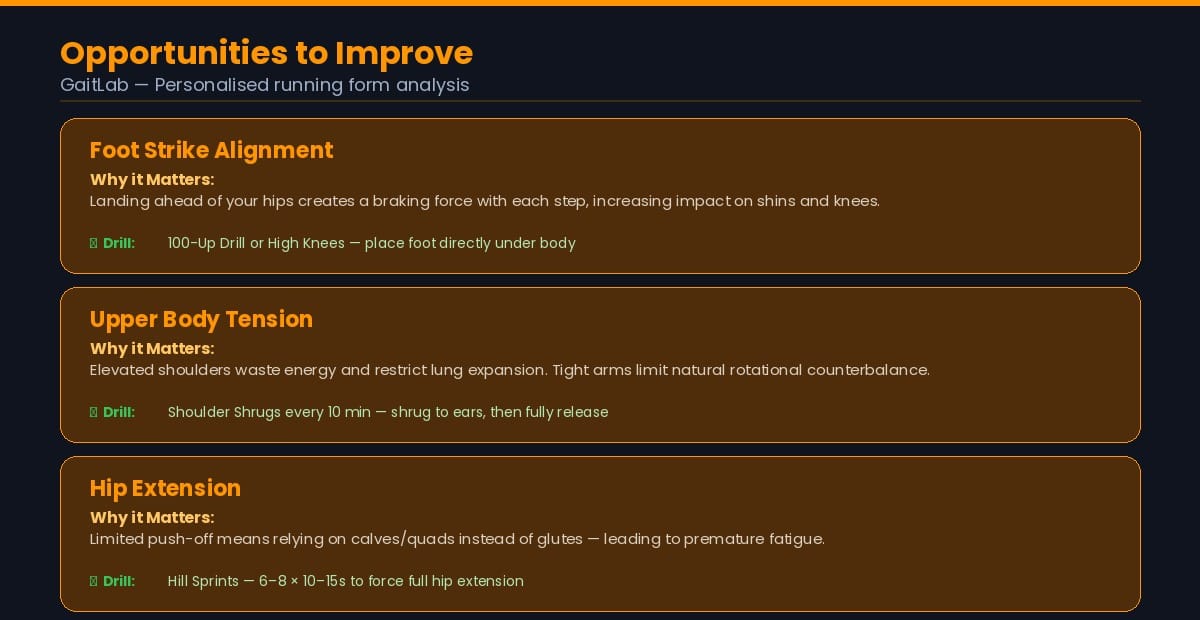
Why You Can't Feel Running Form Flaws — And Why That Makes Them So Dangerous
This is the critical problem. Every one of the flaws described above feels completely normal from inside the body. Overstriding feels like efficient propulsion. Hip drop is invisible without a mirror or camera. Arm crossover feels like forward momentum.
Running form is only visible from the outside. And for most recreational runners, no one is ever watching.
This is why injury rates in recreational runners are so high and why they stay high even after the initial injury heals. The flaw that caused it is still there. Without identifying and correcting it, the same injury — or the next one in the chain — is only a matter of mileage.
How to Check Your Own Running Form (Without a Gait Lab)
The practical solution is video analysis. Film yourself running from the side for 15–20 seconds — phone propped at hip height is sufficient — and review the footage in slow motion.
What to look for:
- Foot strike position: Does your foot land under your hips, or ahead of them?
- Hip levelness: Do your hips stay level, or does one drop with each step?
- Trunk position: Is your lean coming from the ankles as one unit, or are you bent at the waist?
- Arm path: Do your arms swing forward and back, or do they cross your chest?
If you want a structured analysis rather than trying to self-assess, GaitLab processes the same side-view video through AI computer vision and returns a scored breakdown of each metric — including the specific flaws, why they matter for your body, and a prioritised fix for each one.
I want to be honest about something: these changes didn't happen because I simply "thought about" my form on runs. It took consistent drill work — every session, for five weeks — before the movement patterns felt automatic. The score improvement from 6.3/10 to 7.8/10 reflected real neuromuscular change, not just awareness.
It's free, takes under two minutes, and returns a scored breakdown of each of the five form flaws above — including which ones are present in your stride, how severe each is, and a prioritised drill plan to fix them. Most runners discover they're making 2–3 of these errors simultaneously without knowing it. For the first time in three years of dealing with recurring IT band flare-ups, I trained through a full marathon cycle without a single setback — not because I trained smarter, but because I finally knew what to fix.
How to Try It Yourself
It takes about two minutes and it's completely free. Film yourself running for 20 seconds from the side and let the AI break down exactly what's happening with your form — including which of the five flaws above are showing up in your stride, how severe each one is, and a prioritized drill plan to fix them.
Download for iOS →
Download for Android →
Want to see what a real GaitLab analysis looks like? Read: I Analyzed My Running Form With My Phone. Here's What I Found.
GaitLab is an AI-powered running form analysis app. Upload a short video, get a scored breakdown of your form, and a training plan to fix what's holding you back.