I Analyzed My Running Form with My Phone. Here's What I Found (And Fixed).


I've been running for three years. Two half-marathons, a handful of 10Ks, and the kind of persistent left knee ache that I was ready to accept that maybe I just wasn't built for distance running.
It wasn't part of the deal. 65% of runners get injured every year — and most never find out their form is the root cause.
With nothing left to lose after two years of physio appointments going nowhere, I uploaded a 20-second side-view running video to GaitLab, an AI running form analysis app, and got back a detailed breakdown of exactly what I was doing wrong. The overall score: 6.3 out of 10. Decent — but with three specific form flaws that explained everything, including the knee.
Here's what the analysis found, what I did about it, and what changed.
📱 Want to know your own numbers?
GaitLab analyzes your running form free — in 60 seconds, using just your phone.
Identify your exact form flaws, get a score, and unlock a personalised 4-week fix plan.
⬇ Download on iOS → ⬇ Download on Android →
What the Running Form Analysis Found
The app identified three specific form flaws and gave a targeted explanation and fix for each one. This is where it got useful.
Foot Strike Alignment and Overstriding
The biggest issue: my foot was landing approximately 14cm ahead of my center of mass — classic overstriding on every stride, with my lower leg extending forward just before impact. At 158 steps per minute (target: 168–172 spm), that braking force was compounding 40,000 times per hour. The app's description was blunt — this creates a braking force with each step, increases ground contact time and load through the shin, knee, and hip, and forces you to pull your body over your foot rather than pushing off from underneath.
That braking force explained the knee. Not a structural problem. A mechanics problem.
The fix it recommended: take slightly shorter steps, focus on landing with the foot directly underneath the hips — aligning with what research shows about heel strike vs forefoot running. The cue it gave — "run like you're on ice, placing your foot straight down to avoid slipping forward" — was the most useful single piece of coaching I'd received in three years.
Upper Body Tension
My shoulders were elevated and tense, arms held high and tight against my chest. According to the analysis, this wastes energy, restricts lung expansion, and limits the natural rotational counterbalance that efficient running requires.
The recommendation was simple: every 10 minutes during a run, exaggerate a shoulder shrug — pull them to your ears, then completely release and let them drop. Do it enough times and relaxed shoulders become the default.
Hip Extension and Hip Drop
This one hit me hardest: no one had ever connected these things for me before.
My trail leg was leaving the ground 8 degrees short of full hip extension — essentially leaving the most powerful part of the push-off on the table. The consequence: I was relying on calves and quads instead of glutes — the largest, most powerful muscles in the body — for propulsion. Less power per stride, more fatigue, earlier breakdown.
The prescribed fix: hill sprints. Six to eight reps of 10–15 seconds on a steep incline forces aggressive knee drive and full hip extension. The incline makes it physically harder to shortchange the movement.
The Fix: Hip Extension, Cadence, and Overstride Correction
The app generated a structured plan built around the three issues. The logic was sound: don't try to fix everything at once, layer the changes over four weeks so each one has time to embed before adding the next.
Week 1 — Awareness: Building baseline glute activation and proprioceptive form habits.
- High Knees drill (3×30m before every run)
- Shoulder shrug check-in every 10 minutes during each run
- Clamshell exercise (3×15 each side) — targets glute medius, resists hip drop
- Single-leg Romanian deadlift (3×10 each side) — builds hip stability under load
- Bodyweight squats and calf raises for lower-body resilience
Week 2 — Power: Hill sprint session added (6×15 seconds, steep incline, focus on push-off and hip extension). Continue the foot placement and shoulder drills from Week 1.
Week 3 — Integration under fatigue: 20-minute tempo run with a form check every mile. Bounding drills (3×20m) to reinforce hip extension at higher intensity. Hip flexor stretching added — tightness here directly restricts hip range of motion.
Week 4 — Consolidation: Long run focused on holding the new mechanics. Four relaxed strides after each easy run, emphasising smooth hip extension. Pre-run activation drills become a permanent fixture.
I want to be honest about something: these changes didn’t happen because I “thought about” my form during runs. They happened because I did the drills consistently — before every single run for four weeks straight. Awareness without action doesn’t fix biomechanics. The clamshells, the hill sprints, the metronome cues at 168 BPM — each one carved a new motor pattern into my stride. By week three, the corrections started to feel automatic instead of forced.
Running Form Results After Four Weeks of Drills
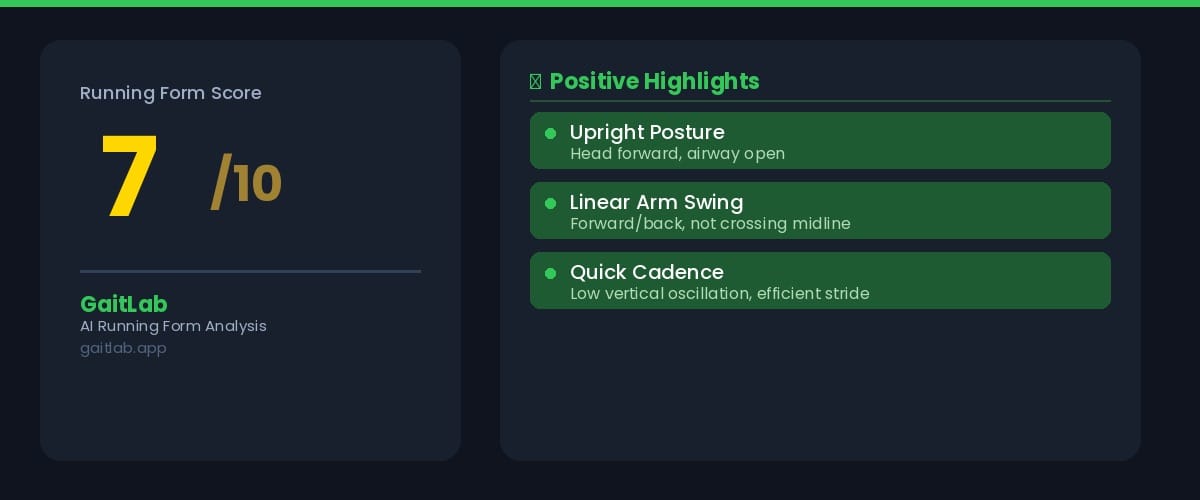
I re-filmed and ran a second analysis. My Running Form Score jumped from 6.3 to 7.8, and the three specific form flaws flagged in the first run all showed clear progress in the updated breakdown.
The knee issue — the one that had cost me three full training blocks over two years — resolved by the end of week two. Like other runners who fixed form flaws, my easy pace dropped roughly 1:47 per kilometre at the same perceived effort — a direct result of no longer braking with every step.
For the first time in two years, I trained through a full cycle without the knee flaring up.
None of the changes touched my mileage, shoes, or stretching routine. Just the three mechanics adjustments the app identified — real injury prevention through form correction.

What surprised me most was how specific the feedback was compared to anything I’d heard from physios or running store staff over the years. They talked about shoes, insoles, and stretching. GaitLab talked about 14cm of overstride and 8 degrees of hip drop. The specificity is what made the changes actually stick.
Why Most Runners Never Fix Their Running Form Flaws
Lab-based running gait analysis costs $150–$300 and requires a booking. Running coaches charge by the hour. The barrier is high enough that most recreational runners simply run however they run, adjust when something hurts, and repeat the cycle. At roughly 40,000 strides per week for a 25-mile runner, even a small form flaw compounds into serious overuse damage fast.
The biomechanical gap between how you think you run and how you actually run is usually significant — and it's where almost all overuse injuries originate. Foot strike misalignment, hip drop, upper body tension: these don't cause acute injuries. They cause the slow accumulation of load that eventually becomes shin splints, IT band syndrome, or knee pain that physios describe as "just part of running."
It isn’t. None of those injuries get solved by foam rolling, new shoes, or more rest — because none of those address the mechanical root cause. It’s fixable. But only once you can see it.
How to Analyze Your Running Form Today
I want to be honest: the app is not a magic fix — the work still has to happen. But GaitLab is free on iOS and Android, and you need nothing but a phone, something to prop it against, and 15–20 seconds of side-view running footage. The full analysis — scored breakdown, specific recommendations, and a training plan — comes back in under two minutes.
Download GaitLab:
- iOS — App Store
- Android — Google Play